What Causes Binge Eating Urges? 7 Triggers That Have Nothing to Do With Food

Most binge eating isn't about hunger — or even food. The real triggers are hiding in plain sight.
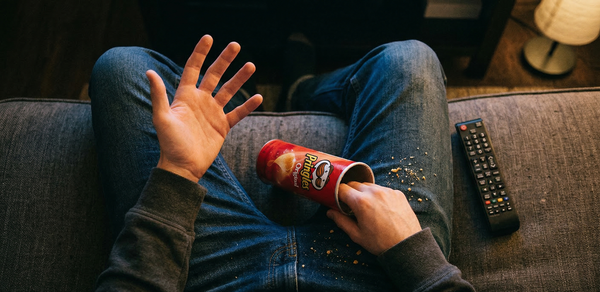
You weren't planning to eat the whole bag. You grabbed a handful of crisps, maybe two. Next thing you know, you're staring at an empty packet wondering what just happened. It felt automatic — like someone else was driving.
That wasn't a lack of discipline. Something fired in your brain before you even made a conscious decision. And the thing that fired it probably wasn't food-related at all.
Here's what's actually behind most binge eating urges — and almost none of it is what you'd expect.
1. You slept badly last night
This one blindsides people. A single night of poor sleep — even just sleeping six hours instead of eight — increases ghrelin (your hunger hormone) by roughly 28% and drops leptin (your satiety hormone) at the same time (Spiegel et al., 2004). That's your appetite thermostat getting cranked up and the off-switch getting disabled simultaneously.
But it gets worse. Sleep deprivation also dials up activity in the amygdala and dampens the prefrontal cortex — the part of your brain responsible for impulse control (Greer et al., 2013). So you're not just hungrier. You're hungrier with worse judgment. That's not a willpower problem. That's a neurochemical setup for a binge.
2. You've been "good" all day
This is the one nobody wants to hear. Restricting food — skipping meals, cutting calories aggressively, labeling entire food groups as off-limits — is one of the strongest predictors of binge eating episodes. Not sometimes. Consistently. Across dozens of studies over three decades (Polivy & Herman, 1985; Stice, 2002).
The mechanism is partly metabolic. Go too long without enough food and your body panics — neuropeptide Y surges, ghrelin spikes, and your brain starts treating calorie-dense food like an emergency resource. But it's also psychological. The moment you tell yourself you "can't have" something, your brain assigns it more reward value. Forbidden food becomes more desirable specifically because it's forbidden. Restriction doesn't prevent binges. It primes them.
3. You're not stressed — you're bored
People assume binge eating is driven by extreme emotions. Sadness, anxiety, heartbreak. And yes, those can trigger it. But one of the most common emotional states linked to overeating is far more mundane: plain old boredom (Crockett et al., 2015).
Boredom creates a low-stimulation state that your brain finds genuinely uncomfortable. Dopamine levels drop. And your brain knows exactly what reliably spikes dopamine back up fast — hyperpalatable food. You're not eating because you're emotional. You're eating because your brain is under-stimulated and it's reaching for the quickest fix available.
This is why binge urges hit hardest on slow Sunday afternoons, not during your busiest workday.
4. You ate something designed to make you eat more
This sounds conspiratorial. It's not. Food scientists have a term called the "bliss point" — the exact ratio of sugar, salt, and fat that maximizes how much you eat before your brain registers satisfaction (Moss, 2013). Products are engineered to sit right at this threshold so you keep reaching for more without ever feeling quite full.
There's also something called vanishing caloric density. Think about how a cheese puff dissolves the instant it hits your tongue. That rapid melt signals to your brain that you haven't consumed many calories — even though you have. So you keep eating. These aren't accidents. They're formulation decisions made in labs with the explicit goal of overconsumption.
If your binge starts with a specific branded product every time, the product is probably part of the problem.
5. Your gut bacteria are lobbying your brain
This one sounds like science fiction, but the evidence is piling up. Different species of gut microbes produce different metabolites — some of which can cross the blood-brain barrier and influence neurotransmitter production, including dopamine and serotonin (Alcock et al., 2014). In other words, the bacteria in your gut can send chemical signals that change what you crave.
A gut microbiome dominated by species that thrive on sugar will, in a very real biochemical sense, push you to eat more sugar. It's not a metaphor. These microbes are producing compounds that influence your brain's reward circuitry. You think the craving is yours. Some of it might literally belong to your microbiome.
6. You're dehydrated and misreading the signal
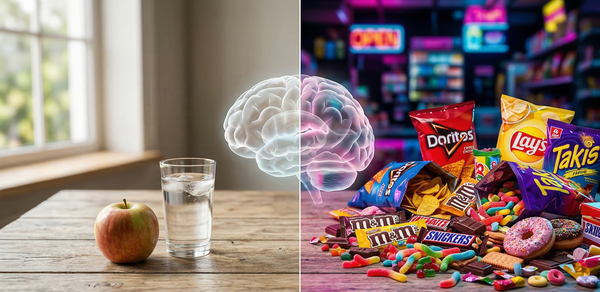
The hypothalamus regulates both hunger and thirst. When you're mildly dehydrated, the signals can cross wires — your brain interprets a need for water as a need for food (Mattes, 2010). It's a simple wiring overlap, but it catches people off guard because nobody thinks to drink water when they feel like bingeing.
Next time an urge hits out of nowhere, drink a full glass of water and wait fifteen minutes. If the urge fades, it was thirst wearing a hunger costume.
7. You're running from a feeling you haven't named
Emotional eating research consistently shows that people who struggle to identify and label their emotions — a trait psychologists call alexithymia — are significantly more likely to binge eat (Pinaquy et al., 2003). The mechanism is almost mechanical: an uncomfortable feeling arises, the brain can't categorize it, so it defaults to the most accessible coping tool — food.
The binge isn't the problem. It's the solution your brain chose because it didn't have a better one available.
The pattern underneath all seven triggers
None of these are about loving food too much. Every single one is about a signal your brain sent that got misinterpreted, misdirected, or hijacked before you had a chance to understand it.
That's the gap CraveShift was built to close. The app catches you at the moment of the urge and helps you figure out what's actually driving it — sleep debt, restriction rebound, boredom, dehydration, an unnamed emotion — before you act on autopilot. No restriction. No guilt. Just the clarity to make a different choice when you actually understand what's going on.
Your binge urges aren't a moral failing. They're unread messages. CraveShift helps you read them.
Download Craveshift for free on iOS and Android
References
Alcock, J., Maley, C. C., & Aktipis, C. A. (2014). Is eating behavior manipulated by the gastrointestinal microbiota? Evolutionary pressures and potential mechanisms. BioEssays, 36(10), 940–949.
Crockett, A. C., Myhre, S. K., & Rokke, P. D. (2015). Boredom proneness and emotion regulation predict emotional eating. Journal of Health Psychology, 20(5), 670–680.
Greer, S. M., Goldstein, A. N., & Walker, M. P. (2013). The impact of sleep deprivation on food desire in the human brain. Nature Communications, 4, 2259.
Mattes, R. D. (2010). Hunger and thirst: Issues in measurement and prediction of eating and drinking. Physiology & Behavior, 100(1), 22–32.
Moss, M. (2013). Salt Sugar Fat: How the Food Giants Hooked Us. Random House.
Pinaquy, S., Chabrol, H., Simon, C., Louvet, J. P., & Barbe, P. (2003). Emotional eating, alexithymia, and binge-eating disorder in obese women. Obesity Research, 11(2), 195–201.
Polivy, J., & Herman, C. P. (1985). Dieting and bingeing: A causal analysis. American Psychologist, 40(2), 193–201.
Spiegel, K., Tasali, E., Penev, P., & Van Cauter, E. (2004). Brief communication: Sleep curtailment in healthy young men is associated with decreased leptin levels, elevated ghrelin levels, and increased hunger and appetite. Annals of Internal Medicine, 141(11), 846–850.
Stice, E. (2002). Risk and maintenance factors for eating pathology: A meta-analytic review. Psychological Bulletin, 128(5), 825–848.