Hunger vs Cravings: The Neuroscience Behind Why You Eat When You're Not Hungry
Your body runs on ghrelin. Your cravings run on dopamine. Here's how to tell which one is talking.
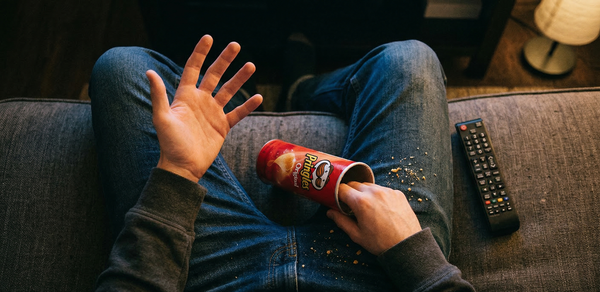
You just had lunch. A proper one — rice, chicken, vegetables, the works. You're full. Your stomach knows it. And yet, 40 minutes later, you're standing in front of the fridge, scanning for chocolate like a detective looking for clues.
That wasn't hunger. That was a craving. And most people go their entire lives without learning the difference — which is exactly how the food industry likes it.
A friend of mine couldn't figure out why she kept "failing"
A colleague — I'll call her Priya — was trying to eat healthier. She meal-prepped every Sunday. Grilled chicken, brown rice, steamed broccoli. She was doing everything the internet told her to do.
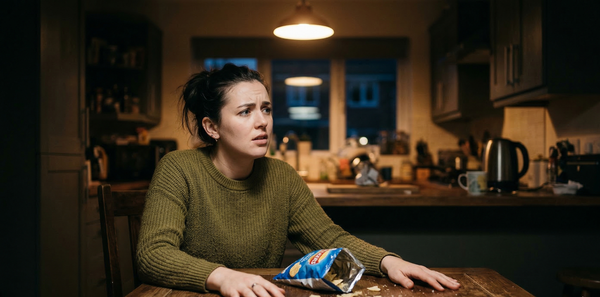
But every afternoon around 3 PM, she'd end up elbow-deep in a bag of salted chips from the office vending machine.
"I don't get it," she told me once. "I'm not even hungry. But I literally cannot stop thinking about those chips."
Priya wasn't weak. She wasn't undisciplined. She was experiencing something neuroscience has spent decades trying to understand — a craving. And cravings operate on a completely different circuit in the brain than hunger.
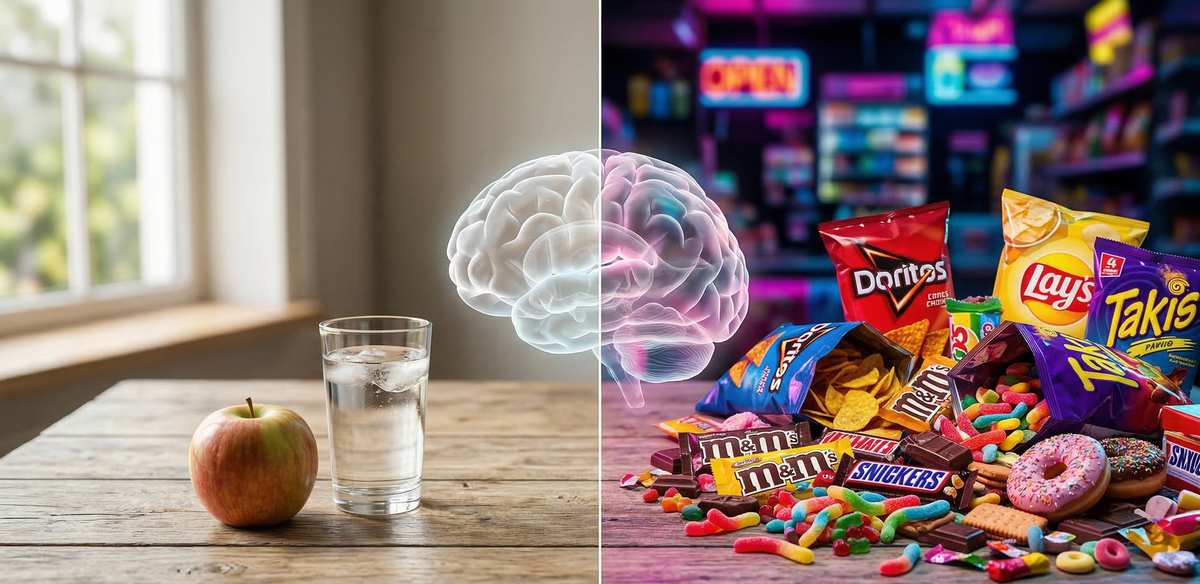
Hunger comes from your gut. Cravings come from your brain.
Real physical hunger is straightforward. When your blood sugar drops, a hormone called ghrelin rises. Ghrelin is made in the stomach, and its only job is to tell the brain: we need fuel. It doesn't care what kind. A banana would work. So would a bowl of dal or a handful of almonds. Hunger isn't picky (Müller et al., 2015).
It also builds slowly. First there's a mild emptiness, maybe a stomach growl. Ignore it and it gets louder — irritability, fatigue, difficulty concentrating. And once you eat enough, ghrelin drops, leptin rises, and the whole signal switches off. Done. System satisfied.
Cravings don't work like that at all.
Cravings originate in the mesolimbic dopamine pathway — the same reward circuitry involved in addiction (Volkow et al., 2011). When you crave chocolate after dinner, your brain isn't saying "you need calories." It's saying "remember how good that tasted last Thursday? Let's do that again."
This is why cravings are almost always weirdly specific. You don't crave "food." You crave that particular ice cream from the freezer. That exact brand of crisps. That one cookie from the bakery near your office. Hunger is open to suggestions. Cravings have already made up their mind.
The dopamine part nobody talks about
Every time you eat something highly palatable — the magic combo of sugar, fat, and salt — your brain releases dopamine. Not because the food is nutritious, but because it registers as rewarding. And dopamine isn't actually the molecule of pleasure. It's the molecule of wanting. It drives you to seek that food again even when your stomach is full (Berridge & Robinson, 2016).
What happens over time is your brain starts linking certain cues to that food. The time of day. A specific emotion. Even a TV show you always watch with snacks. Eventually those cues alone trigger a dopamine spike before you've taken a single bite. That's why you suddenly "need" popcorn the second you sit down for a movie. Nobody's hungry at 9 PM after a full dinner. But the brain has built an association, and it runs the script automatically.
Researchers call this cue-induced craving, and it's one of the most well-documented phenomena in appetite science (Boswell & Kober, 2016). It's not a character flaw. It's pattern recognition doing exactly what it's designed to do — just in a context that doesn't serve you.
A dumb-sounding test that actually works
If you're not sure whether what you're feeling is hunger or a craving, try what I call the broccoli test.
Ask yourself: would I eat a plain bowl of steamed broccoli right now?
If yes — you're probably genuinely hungry. Go eat something real.
If the answer is "no, I specifically want pizza" — that's a craving. Your body doesn't need food. Your brain wants a reward.
It sounds simplistic, but it's rooted in a real concept called sensory-specific satiety. Our desire for a particular food drops as we eat it, but desire for other foods — especially contrasting flavours — stays high (Rolls, 1986). Cravings exploit this by targeting one very specific sensory profile your brain has flagged as rewarding. That's why "I just want something sweet" never actually means you'd happily eat a plain apple.
Willpower is the wrong tool for this job
This is where most diet advice falls apart. They tell you to resist. Fight it. Push through. But research actually shows that trying to suppress a craving makes it stronger. It's called ironic process theory — the more you try not to think about chocolate, the more your brain circles back to it (Erskine & Georgiou, 2010). Anyone who has ever told themselves "I will NOT eat that brownie" and then eaten three of them knows exactly how this plays out.
What works better is understanding the craving rather than battling it. When one hits, there's usually something underneath — stress, boredom, tiredness, dehydration, or just an environmental trigger you haven't noticed yet. Figure out which one it is, and the craving loses its mystery. A craving without mystery is a craving without most of its power.
A study in Behaviour Research and Therapy found that people who practiced observing a craving without acting on it — just watching it rise and fall like a wave — experienced significantly lower craving intensity over time compared to people who tried to suppress or distract themselves (Forman et al., 2007). The craving didn't vanish. It just stopped running the show.
So what actually separates the two?
Hunger builds gradually, comes from the gut, accepts any food, and goes away once you eat. It's driven by ghrelin and triggered by time since your last meal.
Cravings hit suddenly, come from the brain's reward system, demand one specific food, and often don't go away even after you eat. They're driven by dopamine and triggered by emotions, habits, and environmental cues.
Two completely different systems. One gets mistaken for the other dozens of times a week. And every time you confuse them, you eat for a reason that has nothing to do with what your body actually needs.
Where CraveShift comes in
If you're tired of the 3 PM chip run, the post-dinner sweets spiral, or the stress-eating loop that leaves you feeling worse than before — awareness alone won't cut it. You need something in the moment.
That's why we built CraveShift. It's a neuroscience-powered app that helps you decode your cravings in real time. No calorie counting. No restriction. No "just have more willpower" nonsense. It figures out why the craving showed up, what your brain is actually asking for, and gives you a smarter move — one that meets the real need without the guilt spiral afterward.
Your cravings aren't the enemy. They're a signal you were never taught to read. CraveShift helps you read it.
Download Craveshift for free on iOS and Android.
References
Berridge, K. C., & Robinson, T. E. (2016). Liking, wanting, and the incentive-sensitization theory of addiction. American Psychologist, 71(8), 670–679.
Boswell, R. G., & Kober, H. (2016). Food cue reactivity and craving predict eating and weight gain: A meta-analytic review. Obesity Reviews, 17(2), 159–177.
Erskine, J. A. K., & Georgiou, G. J. (2010). Effects of thought suppression on eating behaviour in restrained and non-restrained eaters. Appetite, 54(3), 499–503.
Forman, E. M., Hoffman, K. L., McGrath, K. B., Herbert, J. D., Brandsma, L. L., & Lowe, M. R. (2007). A comparison of acceptance- and control-based strategies for coping with food cravings: An analog study. Behaviour Research and Therapy, 45(10), 2372–2386.
Müller, T. D., Nogueiras, R., Andermann, M. L., Andrews, Z. B., Anker, S. D., Argente, J., ... & Tschöp, M. H. (2015). Ghrelin. Molecular Metabolism, 4(6), 437–460.
Rolls, B. J. (1986). Sensory-specific satiety. Nutrition Reviews, 44(3), 93–101.
Volkow, N. D., Wang, G. J., & Baler, R. D. (2011). Reward, dopamine and the control of food intake: Implications for obesity. Trends in Cognitive Sciences, 15(1), 37–46.